The prestigious infectologist presented together with his team the preliminary results of the research on the early use of convalescent plasma in older adults over 65 years of age with mild COVID-19, which had an efficacy of more than 60 percent.
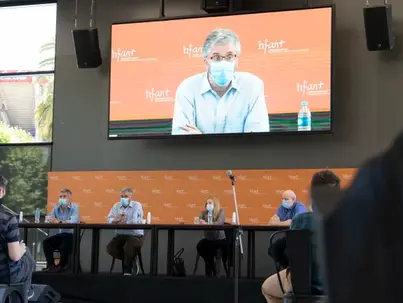
In a week in which promising early results were shown for several vaccines against the disease COVID-19 diseasedisease, good news was also released today regarding the success of a treatment against coronavirus using convalescent plasma.
During a press conference at the Antonio Vespucio Liberti Stadium, the Infant Foundation, headed by the prestigious infectologist Fernando Polack, revealed the preliminary results of the research on the early use of convalescent plasma in older adults over 65 years of age with mild COVID-19, which showed an efficacy of 61% in preventing the coronavirus from developing into a serious disease and evolving only into, in the words of the specialist, "a bad cold".
This "monumental" news announced by Polack and his collaborators meters away from River's stadium has even more relevance in terms of effectiveness, since specialists detected up to 70% effectiveness in people over 75 years of age with no pre-existing diseases, provided it is administered within the first 72 hours of the onset of symptoms.

This study, which is not yet peer-reviewed and is about to be published in an international scientific journal.is the first to show the therapeutic utility of antibody-rich plasma serum against SARS-CoV-2 virus. antibody-rich plasma serum against SARS-CoV-2 virus as early intervention as an early intervention (versus placebo) in adults over 65 years of age. A total of 160 patients with less than 48 hours from symptom onset participated.
To present how the investigation went, Polack used the analogy of a robbery by mentioning that this study can be explained for example as when a thief, in this case the virus, enters a room, which would be our organism. "With the use of plasma early on, we manage to prevent the thief from stealing, that is, that the virus does not manage to develop its serious disease", he analyzed.
In this way, and in line with the use of plasma derivatives -such as hyperimmune gamma globulin and antiviral drugs in other diseases-, antibody-rich plasma acts at the onset of the disease, preventing its progression, antibody-rich plasma acts at the onset of the disease, preventing its progression., unlike trials in severe patients where stopping the progression of COVID-19 becomes more difficult and no conclusive benefit has been found. and no conclusive benefits have been found in its use. Thus, the team administered the plasma at 72 hours of active mild symptoms, in confirmed COVID-19 patients with mild disease. Eleven percent of those who received plasma became severely ill compared to 30% of those who received placebo who were severely ill.
"Plasma is just a vehicle that carries antibodies. Twenty-eight percent of people have, according to our study, the amount of antibodies needed to donate plasma for this treatment. By restricting donors to those with higher antibody concentrations, it is possible to improve the plasma yield even further. Patients who have had pneumonia or needed hospitalization tend to produce the most antibodies," explained Polack.
The researchers identified the desirable amounts of protective antibodies in the plasma bags using the COVIDAR antibody assay developed by the Leloir Institute in Buenos Aires. the COVIDAR antibody assay developed by the Leloir Institute in Buenos Aires. According to the scientists, the findings of the study are an extremely important tool for the design of public policies, as it will allow the design of donation campaigns aimed directly at identifying the right donors, optimizing time, effort and resources.
"This changes the focus of who to administer plasma to .. It is an intervention for that population that will be available long before the arrival of a vaccine for COVID-19 in the country," said Polack."said Polack, who pointed out that unlike other studies performed with plasma when the patient is already in severe disease, the use of this resource so early interrupts the treatment of COVID-19, the early use of this resource interrupts the normal course of the infection and is able to stop the evolution of the severe disease, in which a hospitalization will then be necessary. which will then require hospitalization in intensive care and the need for a respirator.
"This changes the focus of who to administer plasma to .. It is an intervention for that population that will be available long before the arrival of a vaccine for COVID-19 in the country," said Polack."said Polack, who pointed out that unlike other studies performed with plasma when the patient is already in severe disease, the use of this resource so early interrupts the treatment of COVID-19, the early use of this resource interrupts the normal course of the infection and is able to stop the evolution of the severe disease, in which a hospitalization will then be necessary. which will then require hospitalization in intensive care and the need for a respirator.
A different study
As Polack noted in the presentation, "this study describes the world's first strategy to halt the progression of SARS-COV2 with a the world's first strategy to halt the progression of SARS-VOC2 with a cost-effective, universal, off-patent, proven safe intervention that can be administered on an outpatient basis in outpatient units," Polack said. in outpatient units without the need for hospitalization," said Polack.
The design of this study was randomized, double-blind and placebo-controlled. This means that half of the patients randomly received high-antibody titer plasma and the remaining half placebo (physiological solution), with neither physicians nor participants knowing which substance was administered to which individual.without physicians or participants knowing which substance was administered to which individual. This method is used to ensure fairness in the evaluation of the results.
Once all enrolled patients received plasma or placebo, the evolution of the disease in both groups was compared. Of the patients effectively treated with plasma, only 9 needed oxygen against 23 who received placebo treatment. It is estimated that one out of every 6 people treated with plasma who would have had severe disease if they had not received it, did not develop it.
"This is the only This is the only study in the world against SARS-COV2 that was done using this rigorous methodology of early comparison of one group versus another and, therefore, provides evidence that the disease did not progress due to the administration of the plasma and not for other reasons," explained Dr. Romina Libster, Ph, one of the main authors of the study, a pediatric physician specializing in vaccines and a researcher at the INFANT Foundation.
"In March we started thinking about this. In parallel, a list of volunteers was generated to donate plasma. Those with the most antibodies were chosen and extracted. We also went out to look for recovered patients. They were visited at home and swabbed. The positive ones were taken to hospitals and some received placebo and others plasma. They were monitored for 15 days, until they were discharged, and they were visited daily at home to see the results," described Polack.
The study showed that, when analyzing case fatality 28 days after admission, the use of convalescent plasma was significantly associated with a 24.4% reduction in mortality. mortality reduction of 24.4%. The trial, which was carried out between June and October, involved 160 older adults, with an average age of 77 years, divided into two groups. Those over 65 years of age with at least one comorbidity (hypertension, diabetes, obesity, renal failure and/or chronic obstructive pulmonary disease), and then all those over 75 years of age. all those over 75 years of age.
According to Polack, the plasma was used in a single dose and was able to work in patients with comorbidities, a high percentage of the patients on whom it was tested had pre-existing conditions: 75% were hypertensive, 30% were diabetic, and 25% had cardiovascular disease.
The program was a joint effort of the public and private sectors, bringing together hospitals in the province of Buenos Aires and hospitals in the Federal Capital, with the support of the respective Ministry and Secretariat of Health, the PAMI, the Military Hospital, various health actors and hundreds of volunteers.
An independent Data and Safety Monitoring Board (DSMB) oversaw the study by monitoring its quality and patient well-being. The study was funded through a grant from the Bill & Melinda Gates Foundation and the INFANT Foundation's Pandemic Fund Foundation Pandemic Fund, which brings together numerous national companies and private contributors.
The research was carried out with the collaboration of the Instituto de Efectividad Clínica y Sanitaria (IECS) and the Fundación Hematológica Sarmiento at Hospital Dr. Carlos Bocalandro, Hospital San Juan de Dios, Hospital Simplemente Evita, Hospital Central de San Isidro Dr. Melchor Ángel Posse, Clínica Olivos and a network of geriatric care units linked to PAMI in the province of Buenos Aires. Melchor Ángel Posse, Clínica Olivos and a network of geriatric care units linked to PAMI in the province of Buenos Aires, and at the Hospital Militar Central, Centro Gallego, Sanatorio de los Arcos, Hospital Universitario CEMIC, Sanatorio Sagrado Corazón, Sanatorio Anchorena and Sanatorio Finochietto in the Autonomous City of Buenos Aires.
For the study, more than 100 volunteers were trained who helped day and night in the identification of possible patients to be enrolled in the study, coming from their homes and nursing homes in the Buenos Aires suburbs, referred through the collaboration of PAMI, or arriving for consultations at clinics in the Federal Capital.
"During all stages, the project, which involved around 400 people, was involved about 400 people, required meticulousness to assemble the different links and cover both scientific and logistical needs," said Gonzalo Pérez Marc, a pediatrician and deputy director of the Maternal and Infant Department of the Central Military Hospital and also one of the main authors of the work.
This study, conducted with Argentine scientists, is the first evidence in the world of a universal, accessible and safe treatment that can save lives until vaccines are available, is the first evidence in the world of a universal, accessible and safe treatment that can save lives until vaccines are available.
By Víctor Ingrassia-Infobae
Link to the complete article: