
After six months of research, the team led by the infectologist showed encouraging preliminary results of their investigation.
While the vaccines that are now being tested on thousands of volunteers did not exist, plasma was believed to be the "salvation". And many hospitalized people even demanded even demanded it as a treatment against the coronaviruscoronavirus, although it was always a clinical trial.. Afterwards, the plasma lost press in Argentina. Since July its use in critically ill patients was ruled out by Covid-19.
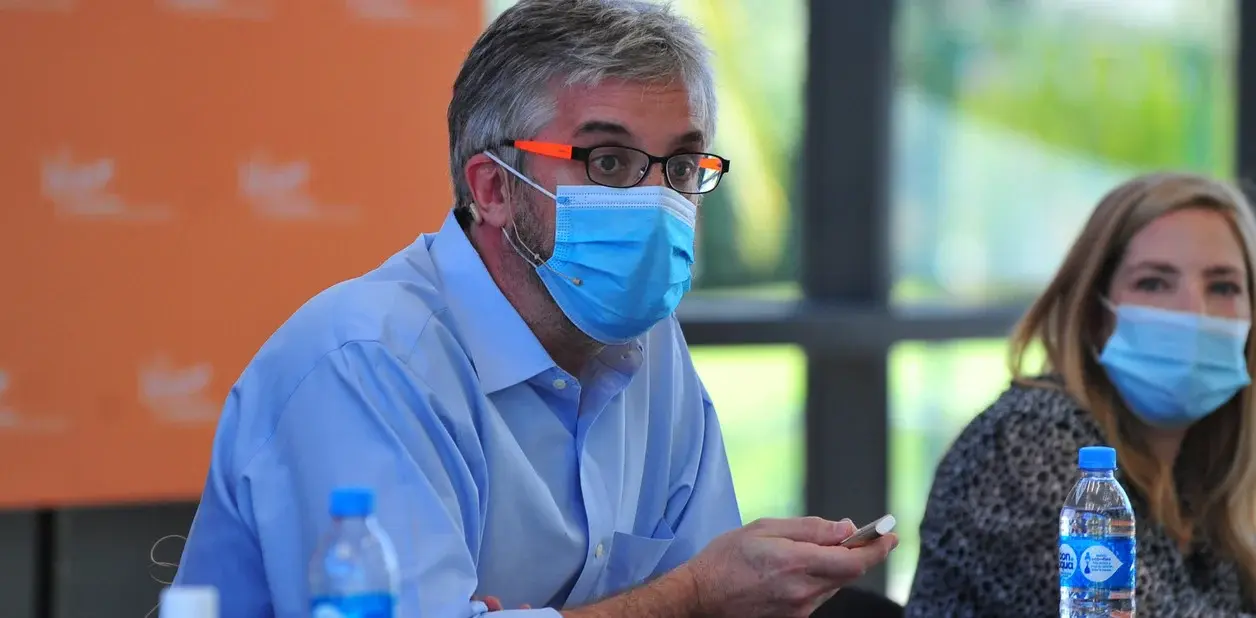
This Thursday, plasma was once again at the center of the pandemic scene. And with a "monumental" news, announced at River's stadium. The Infant Foundation, presided over by the prestigious infectologist Fernando Polackshared this Thursday at noon at the Antonio Vespucio Liberti Stadium's SUM the preliminary conclusions of its research. And they were encouraging.
The study "Efficacy evaluation of early convalescent plasma administration against COVID-19 in older adults" took 6 months, cost $180,000, and determined that plasma had 61% efficacy in preventing severe disease..
"Normally our information is communicated after it is published and peer-reviewed. We decided to convene this meeting to share our initial results. initial results"The specialist pointed out at the beginning of the press conference. And he explained that this research, unlike other studies, "has the central feature of administering the plasma in the first days of infection. We always think of plasma as early administration".
In explaining how the therapy was designed, he used the analogy of a burglar in a room. the analogy of a burglar in a room to point out that with the plasma they wanted the thief (the coronavirus) not to be stopped after it entered and ransacked all the rooms (the body) - "because the damage done would be impossible to repair with plasma" - but they had to stop it from entering the body - "something only a vaccine can do" - so they tried to mimic that effect, stopping the thief during the assault (the course of the disease). Thus, it was administered at 72 hours of active mild symptoms, not in severe patients. Eleven percent of those who received plasma became severely ill compared to 30% of severely ill patients among those who received placebo.
The study met its objective: to reduce the disease to severe progression. The thief was not prevented, it was interrupted once inside. One in 9 people who received plasma became ill, compared to one in 3 who became severely ill among those who received the placebo. The NNT figure for the study was 5.6. Polack explains it easily: "This is the number of people who need to be treated with plasma to prevent the condition from worsening to oxygen requirements. It would be a formula to avoid the collapse of the healthcare system. Treating almost 6 people with plasma (instead of receiving placebo), 1 case is prevented from entering the hospital.

"In March we started thinking about this. In parallel, a list of volunteers was generated to donate plasma. Those with the most antibodies were chosen and extracted," the infectologist recalled at the conference. Regarding the recipients, a group could call and report that they were feeling the first symptoms. "There they were visited in their homes and swabbed. The positive ones were taken to hospitals. Half received placebo and half received plasma. They were monitored for 15 days, until they were discharged, (outpatients) were visited daily at home to see the results," he described. The study was double-blinded: neither doctors nor patients knew which of the two options had been administered to whom.
The volunteers numbered 160 in total, mostly women, with an average age of 77 years. There was a 61% efficacy of plasma in preventing severe disease. "Plasma works if the donor has sufficient antibodies.. It works when administered before 72 hours. It works for mild, not severe patients. There is a time where it can be administered and if it is not too late. And it works in patients over 65. It transforms the coronavirus into a cold."he remarked.
Plasma is used in a single a single dose. It also worked in patients with comorbidities, since a high percentage of the patients in whom it was tested had pre-existing diseases: 30% were diabetic, 75% were hypertensive, 20% had cardiovascular disease. The results of the research were even better in those over 75The results of the research were even better in patients over 75 years of age, where an effectiveness rate of about 70% was achieved. The specialist explained that mild patients must have good saturation, since this is the key requirement for them to be candidates for receiving plasma, according to this study.
What will happen from now on with these results? Polack believes that "it changes the focus of who to give plasma to.". It is still too early to know what the new protocol will be like, but the expert said that "we will meet with the authorities so that it will be possible for patients over 65 years of age to receive it. And he also detailed that "there will be a criterion to define it operationally, but it would be comparable to the moment when someone is assigned as a suspected case, with fever or cough".
He also focused on the need to measure antibodies in donors, in terms of quantity, in order to speed up the system and find the "pearl" donor who has what is needed to cure another person. In this sense, he anticipated that "it is possible that in the future an antibody count will be requested from the patients who are discharged". During the study, it was confirmed that only 1 of 4 donors was useful. This "pearlite" plasma would make it possible to treat 12 people with a single donation.
How the project was born
Polack did not want to shine today. He was the star. Before the conference began, one of the organizers asked someone at the stadium if there was somewhere to "cloister Polack." "That he doesn't want notes," she pointed out. The infectologist did not give a Steve Jobs-like presentation introducing an iPhone. He gave place in the announcement to his colleagues Diego Wappner, Gonzalo Pérez Marc and Romina Libster, part of the great team that worked on the research.
"When a person has coronavirus, at the beginning he/she does not consult. We have to be attentive and consult with early symptoms, so that, if necessary, plasma can be applied," said Libster, one of the general coordinators. And Polack concluded that a second wave a second wave will surely arrive in the countrysimilar to the first. But with vaccines, he anticipated.
This project, one of the most important studies in Latin America for the effective treatment of Covid-19, worked with and monitored the evolution of 210 cases in its initial phase. Later there were 490 cases. In 14 hospitals in the Province and in the City of Buenos Aires How was it born? Under the idea that the plasma in the blood of a person recovered from Covid-19 could cure a person at risk if transfused as soon as the first symptoms appeared. Or, at least, turn the virus into a cold.
"The project seeks to to more or less halve the number of cases of older people who have severe coronavirus disease by about half. The goal is to see if the plasma can sooner rather than later reduce the coronavirus to a viral cold. We have concrete biological grounds to imagine that this is worth testing. But we don't know for sure if it will work", Polack had told Clarín in May. Today he ratified this figure. But he did it without exitism, with moderation: like someone who prepares very well for a difficult oral exam and gets a 7.
Polack had also equated plasma with a vaccine, but those were times when none were being injected into people. Today, Sinopharm's, Pfizer's and Janssen's vaccines are being tested in volunteers in our country, and the Government is moving forward with the purchase of AstraZeneca's and Sputnik V's vaccines.
"Until there is a vaccine to generate defenses in the body against coronavirus, we have to look for a strategy to borrow defenses from elsewhere. The first idea that medicine had more than a hundred years ago was to borrow defenses from people who had had a disease and therefore their immune system already knew about it. That is why these people usually have antibodies circulating in their blood that allow them to defend themselves against a new attack by the same virus," said the director of the research that has now yielded its final results.
The Italian trial
In early October, data were released from a study in 12 health centers in Argentina - which was coordinated by the Hospital Italiano de Buenos Aires - that sought to evaluate the efficacy of convalescent plasma in patients with severe pneumonia. The conclusions of the trial, in which 334 infected patients participated, were not very encouraging.
"The results of the PlasmAr study show that among patients hospitalized with Covid 19 pneumonia with severity criteria, the use of convalescent plasma did not produce a significant clinical benefit at 7, 14 or 30 days of follow-up compared to the use of placebo," the study states.
However, plasma therapy did not aggravate the did not aggravate the condition of the treated patients either: "With regard to the safety profile, there was no statistical difference of the treated patients: "With respect to the safety profile, there were no statistical differences in terms of adverse effects compared to placebo."
Hospital Italiano Central, Hospital Italiano de San Justo, Hospital Universitario Austral, Hospital Ramos Mejía, Sanatorio de la Trinidad, Clínica Zabala, Sanatorio Agote, Clínica Santa Isabel, Hospital Británico de Rosario, Hospital Privado de Córdoba, Hospital Privado de la Comunidad de Mar del Plata and Hospital Zonal Ramón Carrillo de Bariloche took part in the trial.
The researchers emphasized that the results obtained mark "a milestone in therapeutic strategies" for coronavirus mark "a milestone in the therapeutic strategies" for coronavirusThe researchers emphasized that the results obtained mark "a milestone in therapeutic strategies" for coronavirus, since until the time of their publication there was no reliable data on their efficacy.
By Emilia Vexler-Clarín
Link to the complete article: