
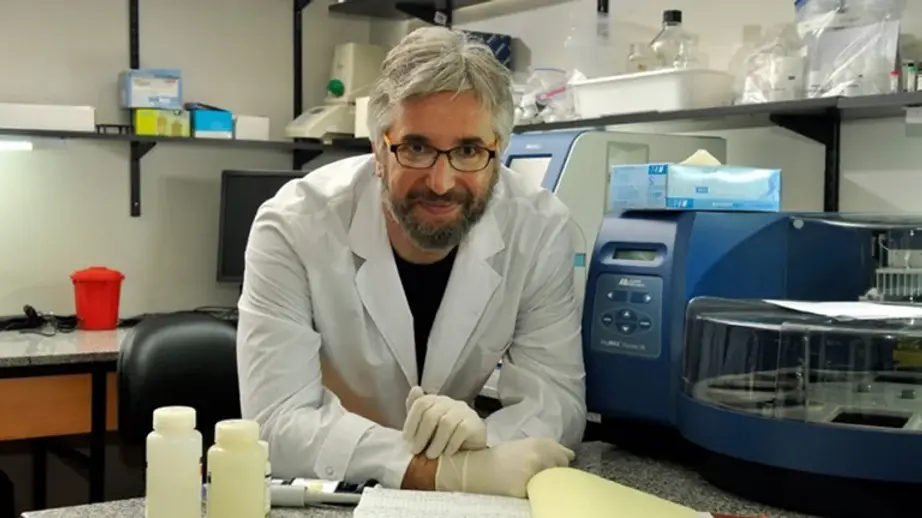
The prestigious physician, one of the world's leading experts in respiratory viral diseases, heads the foundation that is currently investigating whether the plasma of those who have suffered from COVID-19 helps to mitigate the effects of the virus in newly infected patients.
The infectologist Fernando Polack directs the Infant Foundation and is currently is carrying out a study to scientifically prove whether the plasma of patients who have suffered from coronavirus is useful to mitigate the effects on the newly infected patients.. The study -one of several being carried out at this time- is in full swing and the results will be known in a few weeks.
Although it has not yet been scientifically proven that it can be used to treat the coronavirus, the doctor says, campaigns are being carried out to donate plasma from convalescents and its use in patients has begun to be publicly discussed.
Polack explains didactically what plasma is: "Blood has three components. The first is red blood cells, which travel through the circulatory system to the lungs, carry oxygen, and distribute it throughout the body. The second component is white blood cells, which are cells that defend us against infections. In order for the white and red blood cells to circulate there has to be a liquid which is the plasma. Plasma is oily, has proteins, water and salt. One of the proteins are the antibodies that are like pins that trap viruses. When you get infected with coronavirus your white blood cells secrete these antibodies into the plasma. About 28 days after having coronavirus, a person usually has high concentrations of these antibodies swimming around in the plasma. If a virus tries to enter the body, they stick to the surface and immobilize it. The earlier in the infection the antibodies act, the easier it is for them to do their job.
-If it worked, would it be appropriate to apply it at the beginning of the disease?
-Because of how the antibodies act, the application of plasma has a better theoretical chance of working at the beginning of the disease. Because if you get plasma with antibodies in it and lend it to a newly infected person it should immobilize the virus. But all this sounds very logical and is only a theory for COVID-19. The only certainty as to whether this works or not will come from a study in which we compare using it versus not using it.
-Would the plasma of any infected person work?
-The secret is not the plasma itself but the antibodies against the coronavirus that navigate in the plasma. Not all plasma units have high levels of antibodies - we see that in the study - so we need to find those that have the highest amount of antibodies against the coronavirus.
-Has it been scientifically proven to combat coronavirus?
-We do not yet know whether convalescent plasma treats coronavirus. There is no scientific evidence anywhere in the world as of June 25, 2020 that convalescent plasma improves or resolves coronavirus. All we hear are anecdotal reports and have the complication that in those cases where plasma does not work it is highly unlikely to be reported. I can't imagine a family saying that someone received plasma and it didn't work.
-Is it correct that plasma is being administered to the infected?
-Today, until a formal study demonstrates the usefulness of plasma in some population and in some circumstance, the only reasonable use is compassionate use. That is, without knowing if the plasma works, to use it as one of the many measures that physicians use in the hope of saving a life. It is highly likely that in the most critically ill patients plasma will have the least effectiveness, but in those situations medicine gives it all it has even if we never know if it was the plasma that made the difference.
-Why have high expectations been generated about convalescent plasma as a possible cure?
-Today it is only a hope that must be carefully evaluated. If I knew that plasma solves the coronavirus problem, I would not be doing the study I am doing to determine whether it is useful, but rather proposing its distribution. If it is proven that plasma is useful, like all other drugs in the world, it will have very precise indications that will be modified as knowledge expands.
-If the results were positive, what should the treatment be like?
-This is like a treatment for meningitis. You don't treat meningitis in people who don't have it. That is to say, drugs for meningitis are not prescribed to all the inhabitants of the country. The plasma will require studies -which will be completed soon- to define whether it is useful and in which populations it is useful.
-Are the plasma donation campaigns being carried out adequate?
-They are very good if the conviction is maintained that plasma should be used for those indications in which studies show it to be useful. It is essential, so that the people who really need to receive plasma in the future can benefit from it, to establish the groups to be treated as well as specific rules to avoid misusing it. If plasma is to be useful, we will need a strong collective commitment to take care of each other through donations. That is why it is good to accumulate plasma now.
By Omar Lavieri-Infobae
Link to the complete article: