
It is the largest study with plasma from recovered patients that has been done so far in the country. It could become a key tool "as long as there is no vaccine".
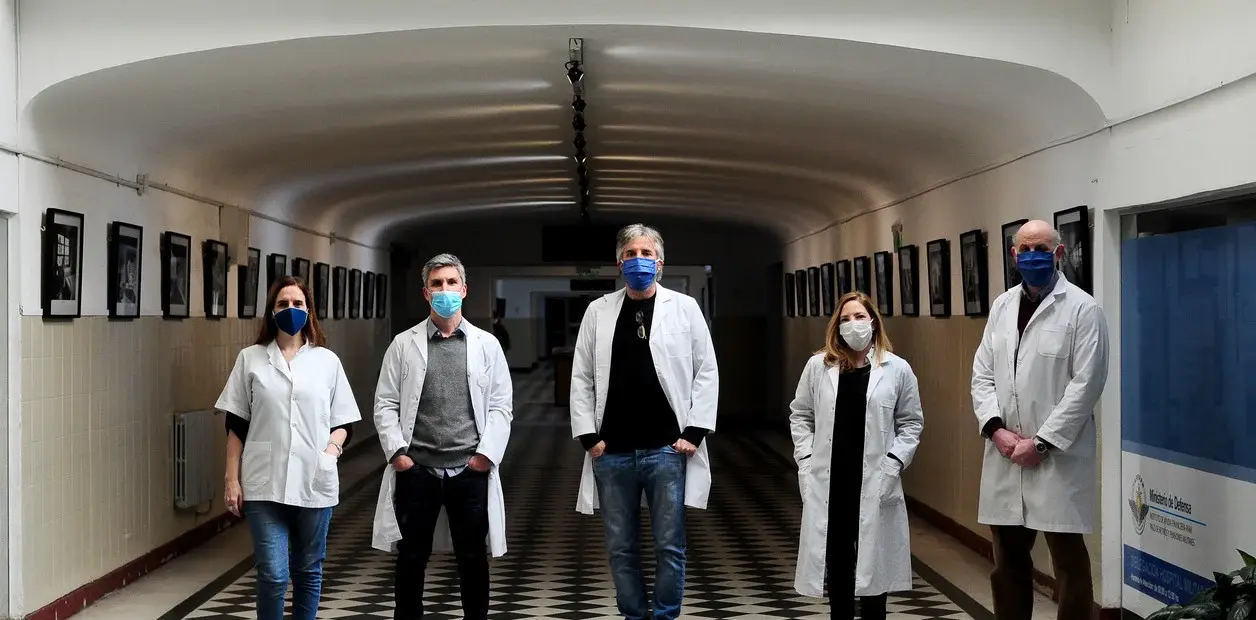
What took at least 18 months to organize was set in motion in just 30 days. In days without pause, while the pandemic pandemic covered the metropolitan region of Buenos Aires like a shadow, a team of doctors led by infectious disease specialist Fernando Polack did the impossible in Argentina: they strung together the wills of the public and private sectors to activate the most ambitious project in the history of respiratory diseases in the country. The "plasma machine" for patients with Covid-19 which, in Polack's own estimation, would prove to be a key tool against the coronavirus "as long as there is no vaccine".. They aim to detect the disease at the first signs of symptoms and convert it, thanks to plasma with antibodies from recovered patients, into a cold.
Clarín witnessed how this sophisticated gear takes off towards a testing ground with real patients where the chances of success are evenly matched with those of failure. But Polack is convinced. The Infant Foundation, which he directs, will pay 180 thousand dollars. All its professionals will donate their salaries. At a later stage, if the efficacy of the treatment is proven, the Bill and Melinda Gates Foundation will come into play to finance the production of intramuscular injections with the antidote. In between, there are a myriad of institutions and professionals involved.
"Until there is a vaccine to generate defenses in the body against the coronavirus, we have to look for a strategy to borrow defenses from elsewhere," Polack points out. "The first idea that medicine had more than a hundred years ago," he says, "was to borrow defenses from people who had already had a disease and therefore their immune system already knew about it. For that reason, these people usually have antibodies circulating in their blood that allow them to defend themselves against a new attack by the same virus".
The study, which in its initial phase will work and monitor the evolution of 210 cases, is born under the idea of mimicking the defenses provided by vaccines as closely as possible. "What would be ideal?"Polack asks. "The ideal would be to generate millions of liters of plasma and give it to all elderly people before they encounter the coronavirus. But that is materially impossible."
What, then, is the objective. The specialist answers realistically: "The project seeks to reduce by more or less half the cases of elderly people who have severe coronavirus disease. The objective is to see if the plasma can sooner rather than later reduce the coronavirus to a viral cold. We have concrete biological grounds to imagine that this is worth testing. But we don't know for sure if it's going to work."
There are different lines of research in the country on the use of plasma. The UBA announced something similar on a much smaller scale a few days ago. The precedents are auspicious. Plasma from recovered patients has been used for decades to treat infectious diseases, including Ebola, H1N1 flu and Mers.
In Argentina, half a century ago, it was implemented by the researcher Julio Maiztegui in the fight against hemorrhagic fever, known as Rastrojos Disease, which caused thousands of deaths. With this technique, the mortality rate of the disease dropped from 30 to 1%. The expectations of Polack, whose fame has skyrocketed since the coronavirus broke out in Argentina, are extremely high.
JOURNEY INTO THE BLOODSTREAM
Blood has three components. The first is the red blood cells, which give it its color and whose job is to carry oxygen throughout the body. "They are like cabs that load oxygen into the lungs' pump and go back and forth, taking that oxygen to the kidneys, to the heart. They unload it and return to the lungs to recharge," Polack explains.
The second component of blood, white blood cells, are the defenses that protect us from infections in a more sophisticated way. And finally, there is the plasma, which is the liquid that allows the blood cells to move through the veins and arteries. Plasma is not water, but a viscous substance. This is because it is full of proteins. One of these proteins is antibodies.
Among other tasks, white blood cells have the function of releasing antibodies into the plasma. Now, there is a type of white blood cell, the b lymphocytes, which are something like antibody factories that roam the blood releasing precisely those antibodies they produce. "When a person has never seen a disease, these lymphocytes cannot produce antibodies, so the virus enters the organism and has a picnic: that is what is happening with the coronavirus," explains Polack.

The specialist adds: "When the patient, on the other hand, has a plasma full of antibodies and can defend itself. These antibodies permeate the virus, they cover it completely like an impalpable sugar coating. It is then that other white blood cells called macrophages appear and, as their name indicates, they eat the virus as if they were a pacman. This impalpable sugar coating makes the virus visible to the macrophages". It is in the midst of this process that the release of antibodies into the plasma occurs. And that is why the plasma of the recovered patients may prove to be an antidote for people who are going to become ill with coronavirus in the coming months in Argentina.
"If we can't generate a vaccine that does all this, the way to make them is to borrow antibodies from one person who had coronavirus. And pass them on to someone else. It's an idea that predates the existence of vaccines," Polack clarifies. "We chose to give the treatment as soon as possible, and we will do it with the so-called double-blind system. To see if that works, we are going to compare that plasma against a similar intervention but with placebo that the eyes look the same. Because it is very important to know if this idea is better, equal or worse than what we are doing today in hospitals."
Polack's multidisciplinary team wants to avoid falling into the hydroxychloroquine falling into the hydroxychloroquine trap.whose recommendation was out loud "and ended up doing more harm than it would have been without ever administering it," say the team's physicians. Medicine, we are learning thanks to the coronavirus, can be very beneficial or very harmful at the same time.
There are different ways to use plasma with Covid-19 patients.. In Argentina, it is generally administered at the end of the disease, when the patient is very ill. "As we want to imitate vaccines, we intend to do it at the beginning," explained the experts, who met at the Hospital Militar Central, during the morning of Sunday by Clarín.
Sophisticated operation
The specialist adds: "When the patient, on the other hand, has a plasma full of antibodies and can defend itself. These antibodies permeate the virus, they cover it completely like an impalpable sugar coating. It is then that other white blood cells called macrophages appear and, as their name indicates, they eat the virus as if they were a pacman. This impalpable sugar coating makes the virus visible to the macrophages". It is in the midst of this process that the release of antibodies into the plasma occurs. And that is why the plasma of the recovered patients may prove to be an antidote for people who are going to become ill with coronavirus in the coming months in Argentina.
"If we can't generate a vaccine that does all this, the way to make them is to borrow antibodies from one person who had coronavirus. And pass them on to someone else. It's an idea that predates the existence of vaccines," Polack clarifies. "We chose to give the treatment as soon as possible, and we will do it with the so-called double-blind system. To see if that works, we are going to compare that plasma against a similar intervention but with placebo that the eyes look the same. Because it is very important to know if this idea is better, equal or worse than what we are doing today in hospitals."
Polack's multidisciplinary team wants to avoid falling into the hydroxychloroquine falling into the hydroxychloroquine trap.whose recommendation was out loud "and ended up doing more harm than it would have been without ever administering it," say the team's physicians. Medicine, we are learning thanks to the coronavirus, can be very beneficial or very harmful at the same time.
There are different ways to use plasma with Covid-19 patients.. In Argentina, it is generally administered at the end of the disease, when the patient is very ill. "As we want to imitate vaccines, we intend to do it at the beginning," explained the experts, who met at the Hospital Militar Central, during the morning of Sunday by Clarín.
The study includes nine institutions, four public hospitals in the Conurbano, with the active collaboration of the Ministry of Health of the Province. The hospitals are the Bocalandro, in San Martín; the San Juan de Dios, in La Plata; the Simplemente Evita, in La Matanza; and the Evita Pueblo, in Berazategui.The patients who agree to be treated with plasma derived from more than 30 hospitals in the Conurbano will go to these hospitals.
Each time a person over 65 years of age arrives at a hospital there will be an expert who will inform him about the study and invite him to participate. If he/she accepts, he/she will be transferred to one of the four reference hospitals. All people who call 148 of the Province of Buenos Aires or specific lines of nearby municipalities will also be informed and, if they accept, they will be transferred with ambulances of Swiss Medical's Eco service.
In addition, the government of the City of Buenos Aires is also participating. The City's reference hospital is currently being defined, in addition to the active participation of the Sanatorio de los Arcos, the Cemic, Osecac, the Finochietto sanatorium and, in a coordinating role in several cross activities, the Central Military Hospital. A valuable contribution from the private sector is made by the Vistalba winery, from the province of Mendoza.
The research is led by six peopleTwo general coordinators, Romina Libster and Gonzalo Perez Marc. A clinical group leader of physicians, Diego Wappner, who works with the medical director of Los Arcos, Jorge Lantos, and the Medical Director of Cemic, Ricardo Valentini. And one person responsible for ensuring that the study conforms to the regulatory standards of all participating institutions, Silvina Coviello. In addition to Alejandra Bianchi in the general coordination of almost all the areas.
The main operation is made up of more than 190 health professionals who are being trained against the clock, 120 volunteers, 15 outstanding students of the last year of their medical career at UBA. who are currently being trained against the clock, 120 volunteers, 15 outstanding students in their final year of medical school at the UBA. And a variety of organizations such as the IECS (Institute of Clinical and Health Effectiveness), which will be in charge of collecting and processing the results in real time.
Everything that is not seen and will not be seen. Massive trainings by Zoom... Motorcyclists ready to transport biological material and speed up the results of swabs. Diagnostics in speed and calibration of formula 1 boxes and links that are assembled for an overcoming objective: to be able to fight against a disease that, as long as there is neither vaccine nor treatment, will continue to impose the rules of the game.
Gonzalo Sánchez-Clarín
Link to the complete article: