
"It's half miraculous," the Infant Foundation director emphasized about its efficacy.
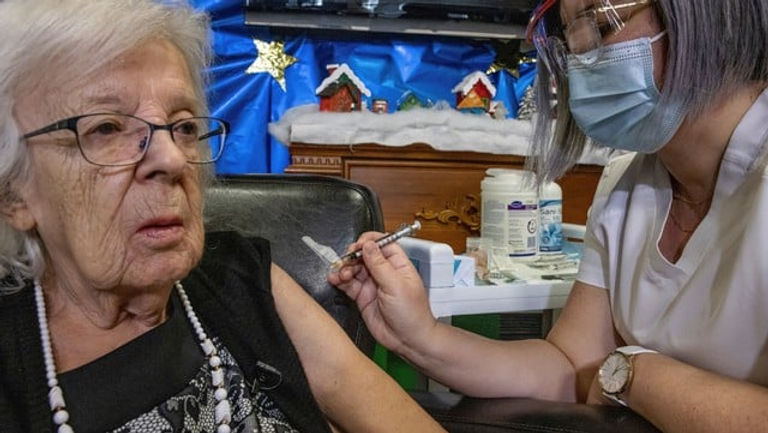
After the United States, Mexico and other countries authorized the use of the Pfizer-BioNTech vaccine, the infectologist Fernando Polack assured that in Argentina, this vaccine "had an efficacy of 97%" in the clinical trials.
In declarations to Marcelo Longobardi's program "Cada Mañana", on Radio Mitre, the director of the Infant Foundation where the clinical studies were carried out said that it is even "half miraculous", due to the efficacy it showed.
Polack spoke to the journalist about a document that was published last week in a health magazine about the Pfizer vaccine, which "is the report of the 44,000 volunteers who participated in the study, including the 5,700 or so Argentines".
"There were 128 sites in the world. We were a site that particularly attracted a lot of volunteers. We were the one that contributed the most patients and detected the most Covid-19 cases. A study is only as big as the number of cases it detects. And in Argentina the vaccine had an efficacy of 97%. There was only one patient among all those vaccinated, which means that it worked phenomenally well", the infectologist explained.

However, he clarified that the Foundation is "totally outside" the regulatory processes for the vaccine. "Our task is to bring the vaccine opportunity closer to the government in terms of bringing the trial," Polack explained.
As to whether this could be the beginning of the end of the disease, he said it is likely, but that "doesn't mean it's the end of the pandemic today."
"Imagine the scenario if this study had failed. We would be in the hands of the virus as in the beginning, and now this very clear opportunity appears that, in some way, can multiply infinitely," he said.
According to the expert, if in CABA "you vaccinate 700,000 people of legal age and you could eliminate the risk of people dying of coronavirus, you would be left with people who would be bedridden and the disease would be different".
In addition, he said that in this way "you create an arsenal of treatment, plasma sachets for those who develop the disease, and essentially you create an umbrella where the pandemic begins to lose strength".
Regarding the conservation of the vaccine, he corroborated that the Pfizer vaccine "needs to be kept at a very low temperature", which today is "70 degrees below zero". However, he explained that this is not a problem. "When you say that and you are not in this environment, you think: 'It's impossible', don't you? But all research freezers are at minus 70 degrees. It's not a thing that doesn't exist. So, there are a lot of resources where you can anchor them for use in the big cities of the world."
"It is true that with the Pfizer vaccine you will not be able to vaccinate easily in a remote area of a province, but that is not the objective of this vaccine today," he clarified.
"When you get on a plane, what you want is that there are experts in the mechanics and operation of the whole plane, that they have checked them. The issue of vaccines is that there should be experts who know very well what is inside the vaccine, who have checked the whole process so that you can be at ease", he said.
"We had two ANMAT visits lasting 11 days each. Four experts from ANMAT came and spent all these days reviewing everything we do from top to bottom. I am not only proud of this, but it also gives me peace of mind because I know that in other processes they do the same as they did with us," he continued.
He went on to say that Pfizer's vaccine "is half a miracle." "When we waited for the results, I didn't even remotely expect what happened. I think Moderna is going to have the same efficacy because it's very similar, it's like the twin sister. And AstraZeneca, although it has less efficacy than these, it's a good vaccine at 60%. A 40% vaccine is a good vaccine", the infectologist informed.
Clarín Note
Link to the complete article: